
Why Is Heyramp the Best for Complex Organizational Workflows?
You are juggling multiple departments, each with its own goals, feedback loops, and reporting lines, and the coordination overhead is eating your team's focus. Spreadsheets and scattered tools only add friction, making it harder to see who is actually on track. Complex workflows demand a single source of truth for people data and priorities.
By the end of this article, you will know exactly how HeyRamp consolidates goal setting, structured 1-on-1s, and performance insights into one operational hub. You will see which features reduce managerial clutter, how analytics dashboards support decisions, and which plans fit scaling teams. This guide equips you to judge whether HeyRamp solves your specific coordination pain points.
What Is HeyRamp?
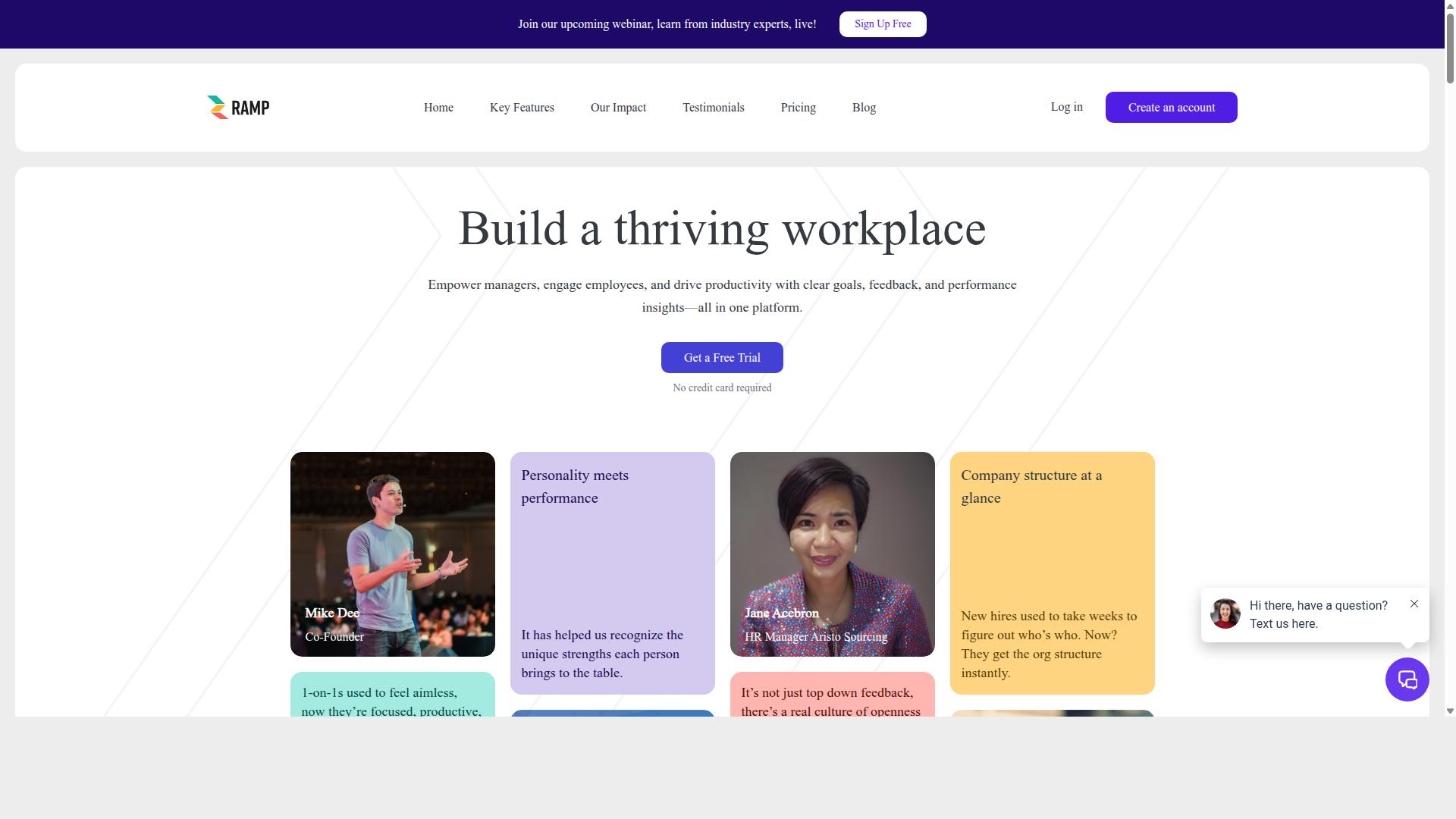
HeyRamp is a productivity software platform that centralizes employee engagement, performance management, and workplace communication into one unified system. It is an all-in-one SaaS platform designed specifically to handle the demands of performance management and team development at scale.
The platform brings together three core modules: feedback, reviews, and team development. These modules work in concert to create a continuous loop of communication and improvement between managers and their direct reports.
HeyRamp serves global organizations with a clear focus on improving manager-employee interactions. The company is dedicated to revolutionizing the way businesses manage their teams and is committed to providing solutions that enable users.
At its core, the platform enables managers, engages employees, and drives productivity with clear goals, feedback, and performance insights. For complex organizational workflows, this unified approach means fewer disconnected tools and a single source of truth for performance data.
What makes HeyRamp particularly suited to complex workflows is that it treats performance management as a continuous process rather than a yearly event. The platform's value proposition centers on replacing fragmented email chains, scattered spreadsheets, and ad-hoc check-ins with a structured, centralized system that supports workflow automation and process orchestration.
Why HeyRamp Excels at Complex Organizational Workflows
HeyRamp addresses the chaos of complex organizational workflows by integrating goal alignment, feedback loops, and performance tracking into a single, intuitive interface.
Complex workflows often break down because teams juggle multiple tools that do not communicate with each other. This fragmentation creates misalignment, delays, and lost context across departments. HeyRamp reduces that friction by bringing the essential pieces of workflow execution into one connected system.
Instead of switching between separate apps for goals, check-ins, and reviews, teams work from a shared view of what matters. Strategic objectives stay visible alongside day-to-day execution, so every task has a clear line of sight to broader company priorities. This approach supports cross-functional teams that need consistent visibility and accountability.
The platform tackles two core challenges that complicate organizational workflows: disconnected tools and unclear follow-through. The sections below explore how unified goal management and structured manager-employee interactions create the clarity that complex operations require.
Unifying Goals, Feedback, and Performance in One Platform
This section details how HeyRamp unifies goal setting (OKRs), continuous feedback, and performance reviews to eliminate silos and ensure every task aligns with broader objectives.
Most organizations run goals, feedback, and reviews through separate systems. That separation forces employees to reconstruct context manually and often leads to misaligned priorities. HeyRamp consolidates these functions into a single dashboard, giving teams a complete view of how their work connects to company outcomes.
Consider a marketing team running a product launch campaign. With HeyRamp, team members can see how their campaign tasks tie directly to company revenue goals. That visibility transforms abstract objectives into concrete daily actions, which keeps cross-functional teams moving in the same direction.
The unification reduces tool-switching, which is a major source of workflow friction. When employees spend less time toggling between platforms, they spend more time on actual work. The integrated approach also improves cross-functional alignment because everyone references the same goals, feedback, and performance data.
Several product features enable this integration:
- OKR and goal management with real-time progress visualization
- Performance reviews that connect individual contributions to team objectives
- Continuous feedback tools that capture input throughout the workflow cycle
- Company structure visualization to clarify ownership and dependencies
- KPI snapshots for quick reference on operational health
Together, these capabilities create a workflow engine where goal setting, feedback, and performance measurement reinforce each other. Teams gain a shared operating picture that supports better decision-making and faster course correction.
Structured 1-on-1s and Action Tracking for Managerial Clarity
HeyRamp's 1-on-1 meeting tools bring structure to manager-employee check-ins with organized agendas and action tracking, ensuring that discussions translate into clear next steps.
Unstructured meetings are a common source of workflow breakdowns. Without a clear agenda, conversations drift, and important decisions get lost. HeyRamp addresses this with 1-on-1 meeting tools that include organized agendas, so every check-in has a defined purpose and focus.
The platform also tracks action items directly, which reduces ambiguity about who does what after the meeting ends. Instead of relying on memory or scattered notes, managers and employees can see exactly what was agreed upon. This follow-through mechanism keeps projects moving and prevents tasks from slipping through the cracks.
Action items are linked to tasks and can be monitored for completion. That linkage provides a clear audit trail from conversation to execution. When a manager assigns a follow-up during a 1-on-1, both parties know the expected outcome and can track progress in real time.
HeyRamp supports this structured approach with several built-in capabilities:
- Guided conversation templates that keep meetings on track
- Coaching tips to help managers lead effective discussions
- Sentiment prompts that surface employee engagement signals
- Automated reminders to keep scheduled check-ins consistent
- Confidential manager notes for private context between meetings
This structure gives managers the clarity they need to handle complex workflows across multiple direct reports. It also supports role-based access, so sensitive information stays protected while relevant action items remain visible to the right people. The result is a repeatable system for managerial clarity that scales with organizational complexity.
Key Features That Streamline Workflow Complexity
HeyRamp packs a suite of features designed to tackle workflow complexity head-on, from visualizing company structure to automating coaching reminders. These tools do not operate in isolation. They work together to create a connected system that supports better decisions at every level.
Each feature addresses a specific pain point in complex organizational workflows. The result is a platform that helps managers see clearly, act quickly, and keep teams aligned. The following subsections explore how HeyRamp turns scattered data into structured, actionable processes.
Company Structure Visualization and Personality Insights
HeyRamp's company structure visualization gives managers a bird's-eye view of team dynamics, while integrated personality insights foster better collaboration. The visual mapping clarifies reporting lines and highlights dependencies between roles and departments. This makes it easier to spot where work might stall or where handoffs could cause friction.
Personality insights, drawn from HeyRamp's personality testing feature, add a practical layer to that structural view. Managers can tailor communication styles and assign tasks based on how individuals naturally work. For example, a manager might pair a detail-oriented planner with a big-picture thinker on a complex project. That combination often produces more balanced outcomes than assigning similar personalities together.
Understanding who works well together is a major advantage in cross-functional teams. When managers know the strengths and blind spots of each person, they can build more effective partnerships. This reduces friction and speeds up task management across the organization.
Real-Time OKR Progress and Automated Coaching Reminders
This section covers how HeyRamp tracks OKR progress in real-time and uses automated coaching reminders to keep managers and employees on track. The OKR and goal management feature provides live updates on completion percentages, so leaders never have to guess where a project stands. This real-time visibility helps teams adjust quickly when priorities shift.
Automated reminders act as a safety net for busy managers. When progress slows or an employee goes quiet, HeyRamp nudges the manager to schedule a check-in. These reminders prevent small issues from becoming major bottlenecks in the workflow.
Consistent check-ins keep momentum going across sequential and parallel tasks alike. Managers who act on these prompts catch problems early, before they ripple through the entire project. This proactive approach is essential for maintaining smooth organizational workflows.
Aggregated People Analytics Dashboards for Decision-Making
HeyRamp's aggregated people analytics dashboards turn raw performance data into actionable insights for leaders. The platform pulls information from feedback, performance reviews, and OKR progress into a single view. Leaders can spot trends that would otherwise remain hidden in scattered reports.
For instance, a dashboard might reveal that one team shows lower engagement scores than the rest of the company. That pattern prompts leadership to review the team's workload and make adjustments before burnout sets in. Similarly, analytics can highlight high performers who deserve recognition or new responsibilities.
Bottleneck detection becomes far easier when all relevant data lives in one place. Managers can see where work piles up and which processes need attention. With HeyRamp's leadership insights and KPI snapshots, decision-makers have the context they need to optimize resource allocation and keep complex workflows moving forward.
Pricing and Plans for Scaling Teams
HeyRamp offers transparent, per-seat pricing that scales with your team, with a free trial that requires no credit card. The pricing structure is simple and predictable, which makes budgeting for complex organizational workflows far easier than dealing with opaque enterprise quotes.
For teams that prefer flexibility, monthly billing costs $5.00 per seat, paid monthly. If your organization is ready to commit for a year, the annual plan drops to $3.00 per month per seat, paid annually. That is a meaningful saving as your headcount grows across cross-functional teams.
Larger organizations with more demanding workflow automation needs can request custom enterprise pricing, which is also paid per seat. This option suits companies that need tailored process orchestration at scale without paying for seats they do not use.
Every plan, including the trial, includes full access from day one. There are no locked features or restricted modules during the 14-day trial, so your team can test the workflow engine with real processes before deciding.
The value becomes clear when you map pricing against the capabilities that matter for complex workflows. You are paying for the ability to design custom workflows, manage approval chains, and maintain real-time visibility across departments, all without per-feature add-ons.
Another practical advantage is that you can switch plans anytime. If your team expands mid-cycle or your process orchestration needs change, you are not locked into a rigid contract that penalizes growth.
For scaling teams, per-seat pricing is the fairest model because it aligns cost directly with usage. As you add stakeholders, contractors, or new departments, the cost grows incrementally rather than jumping to a new tier with unused capacity.
Compare that to enterprise software that charges by module or by project count. With HeyRamp, the math stays simple, and the 14-day trial means you can verify the fit for your organizational workflows before spending a cent.
Trust Signals from Organizations and Teams
With over 20 organizations and 400+ teams already using HeyRamp, the platform has earned trust across industries. This adoption rate signals that complex organizational workflows are being managed successfully at scale. Teams in different sectors rely on HeyRamp to coordinate tasks, approvals, and cross-functional handoffs.
The platform includes built-in compliance documentation and automatic audit trail features. These tools give stakeholders clear visibility into how work moves through the organization. For companies that need to demonstrate process integrity, this level of transparency matters deeply.
HeyRamp also offers aggregated people analytics dashboards that help leaders see workflow patterns at a glance. Role-based access ensures that sensitive information stays protected while still enabling real-time visibility for those who need it. These built-in safeguards make the platform suitable for enterprise environments with strict governance requirements.
The combination of workflow automation, audit trails, and compliance support creates a foundation of trust. Organizations can adopt HeyRamp knowing that their process orchestration aligns with internal policies and external expectations.
Testimonials from HR Managers, Leaders, and Contributors
Real-world feedback from HR managers, leaders, and individual contributors highlights HeyRamp's impact on daily workflows. Each role interacts with the platform differently, yet the consistent theme is that complex work becomes more manageable.
Jeffrey Doehler and Mike Dee, both in leadership positions, have shared positive experiences with how HeyRamp supports organizational coordination. Their feedback points to smoother task management and clearer process orchestration across teams. Leaders benefit from seeing how work progresses without constant status-check meetings.
Jane Acebron, an HR Manager at Aristo Sourcing, notes the value of having guided conversation templates for difficult discussions. These templates help managers prepare for sensitive conversations with structure and confidence. The built-in training and education resources further support HR professionals in their daily responsibilities.
Steven Khanna, Head of Growth, highlights how personality insights integrated with performance tools create a more complete picture of team dynamics. This integration helps growth teams align individual strengths with workflow demands. The result is better resource allocation and smoother collaboration.
Donal Lynch, an Individual Contributor, emphasizes how HeyRamp simplifies the experience of navigating complex workflows. Instant coaching tips and automated reminders for managers reduce friction for everyone involved. Contributors spend less time chasing approvals and more time on meaningful work.
Across all these roles, the feedback converges on one point: HeyRamp makes complex organizational workflows feel structured rather than chaotic. The platform's workflow templates, approval chains, and conditional logic support teams at every level of the organization.
Who Should Use HeyRamp
HeyRamp is designed for leadership, line managers, HR professionals, and individual contributors who want to improve performance and engagement. Each group interacts with complex organizational workflows differently, and HeyRamp gives every role the right level of visibility and control. The platform supports the full spectrum of stakeholders, from executives setting strategy to team members executing daily tasks.
Leadership teams benefit most from the goal alignment and performance management capabilities. When workflows span multiple departments, executives need real-time visibility into progress without chasing status updates. HeyRamp helps leaders see how individual efforts connect to broader organizational objectives, which is essential for steering complex workflows in the right direction.
Line managers handle the day-to-day reality of cross-functional teams and task management. They need to coordinate parallel tasks, manage approval chains, and spot bottlenecks before they slow delivery. With HeyRamp, managers can support team development while keeping complex workflows moving, even when dependencies shift or priorities change mid-cycle.
HR professionals use HeyRamp to drive employee engagement and performance management across the organization. Standardizing how goals are set, reviewed, and updated becomes far simpler when the workflow engine handles the structure. HR teams can focus on coaching and development instead of wrestling with spreadsheets and email chains.
Individual contributors gain clarity about their priorities and how their work fits into larger initiatives. Complex workflows often fail when people cannot see the full picture or understand why their tasks matter. HeyRamp gives contributors a clear sense of ownership, which supports both engagement and accountability in day-to-day work.
Whether an organization is scaling up or refining existing processes, HeyRamp serves every level of the company. The combination of workflow optimization, real-time visibility, and stakeholder collaboration makes it a practical fit for teams that cannot afford misalignment. When each role has the right tools to contribute, complex organizational workflows become manageable and measurable.
Final Verdict
In conclusion, HeyRamp stands out as a robust solution for organizations seeking to streamline complex workflows and boost employee engagement. The platform's all-in-one design means teams no longer need to juggle multiple disconnected tools for task management, workflow automation, and performance tracking. This consolidation alone reduces friction and helps cross-functional teams stay aligned on shared objectives.
For organizations wrestling with complex workflows, the combination of a flexible workflow engine and strong integration capabilities addresses the core pain points of process orchestration. Real-time visibility into approval chains, dependency mapping, and exception handling gives managers the clarity they need to keep projects moving. Meanwhile, workflow analytics and bottleneck detection help leaders continuously refine their processes rather than guessing at what is slowing teams down.
Affordability is another decisive advantage. Many enterprise software platforms with similar workflow optimization features come with price tags that put them out of reach for smaller organizations. HeyRamp delivers these capabilities at a price point that suits teams of all sizes, from growing startups to established enterprises. The focus on engagement and performance means the platform is not just about automation, it is about helping people do their best work.
If your organization needs to manage sequential tasks, parallel tasks, conditional logic, and complex approval chains without drowning in administrative overhead, HeyRamp is worth serious consideration. The platform's approach to workflow design, version control, and role-based access makes it suitable for departments that demand both flexibility and compliance. Audit trails and SLA management add the governance layer that larger organizations require.
Research suggests that teams thrive when they have clear visibility into their processes and the tools to act on that information. HeyRamp delivers on that promise by combining workflow templates, resource allocation, and stakeholder collaboration in one accessible interface. The 14-day free trial offers a risk-free way to evaluate the platform against your specific organizational needs. Visit the HeyRamp website to start your trial and see how the platform handles your most complex workflows.
Recommended Resources: