
Top 7 Alternatives of Weekdone for OKR Tracking
Your OKR tracking tool keeps showing you progress charts nobody updates, and weekly check-ins feel like busywork instead of direction. Many teams hit this wall after a few quarters, when the software's limits start slowing down momentum. You need a tool that keeps goals visible and tied to actual performance, not just a dashboard.
This guide covers the seven best Weekdone alternatives, starting with what to check in any OKR platform: real-time tracking, integrations, and user experience. You will walk away with clear criteria for comparing Lattice, Leapsome, 15Five, Culture Amp, Perdoo, Workleap, and our top pick, HeyRamp, so you can make a decision based on fit, not hype.
What to Look For in OKR Tracking Alternatives
Before evaluating specific tools, it's essential to define the criteria that matter most for your team's OKR success, from core features to integration ease. The right OKR software should align with how your organization already plans, communicates, and measures performance.
Use these five criteria to compare Weekdone alternatives fairly: core OKR features, real-time updates, integration capabilities, user experience, and scalability. Each alternative in this guide will be assessed against these benchmarks to help you make an informed decision.
Core OKR Features and Real-Time Progress Tracking
Look for tools that allow you to set objectives, define measurable key results, and update progress in real time to keep everyone aligned. The best OKR platforms support the full goal-setting cycle, from creating company objectives to cascading them down to individual OKRs.
Essential features to evaluate include the ability to assign owners, set due dates, and track completion through percentage updates or status indicators. Visual progress bars and automatic updates from connected tools make it easy to see where things stand during weekly check-ins and quarterly reviews.
Real-time progress tracking matters because it eliminates the need for manual status reports. When a key result updates automatically, managers can spot risks early and adjust priorities before the end of the OKR cycle.
Consider whether the tool supports agile goal setting, where objectives can be adjusted mid-quarter without losing historical data. Some OKR software also offers templates for common goal types, which can speed up the planning process significantly.
Integration Capabilities and User Experience
A tool's value multiplies when it integrates seamlessly with your existing stack and offers an intuitive interface that encourages adoption. Look for OKR software that connects with the tools your team already uses daily, such as Slack for communication, Jira for task management, and Salesforce for customer data.
Integrations enable automatic progress updates, which means less manual data entry and more accurate KPI monitoring. When an OKR platform syncs with your HRIS system, it can also help with employee alignment and performance management across the organization.
User experience is equally important. The best OKR tools have a minimal learning curve, allowing both managers and individual contributors to navigate effortlessly. An analytics dashboard should provide clear insights into progress trends without requiring extensive configuration.
To evaluate user experience, request a demo or trial before committing. Test how quickly you can create an objective, assign key results, and view progress reports. If the interface feels cluttered or confusing during a trial, it will likely frustrate your team during daily use.
1. HeyRamp - Best Overall
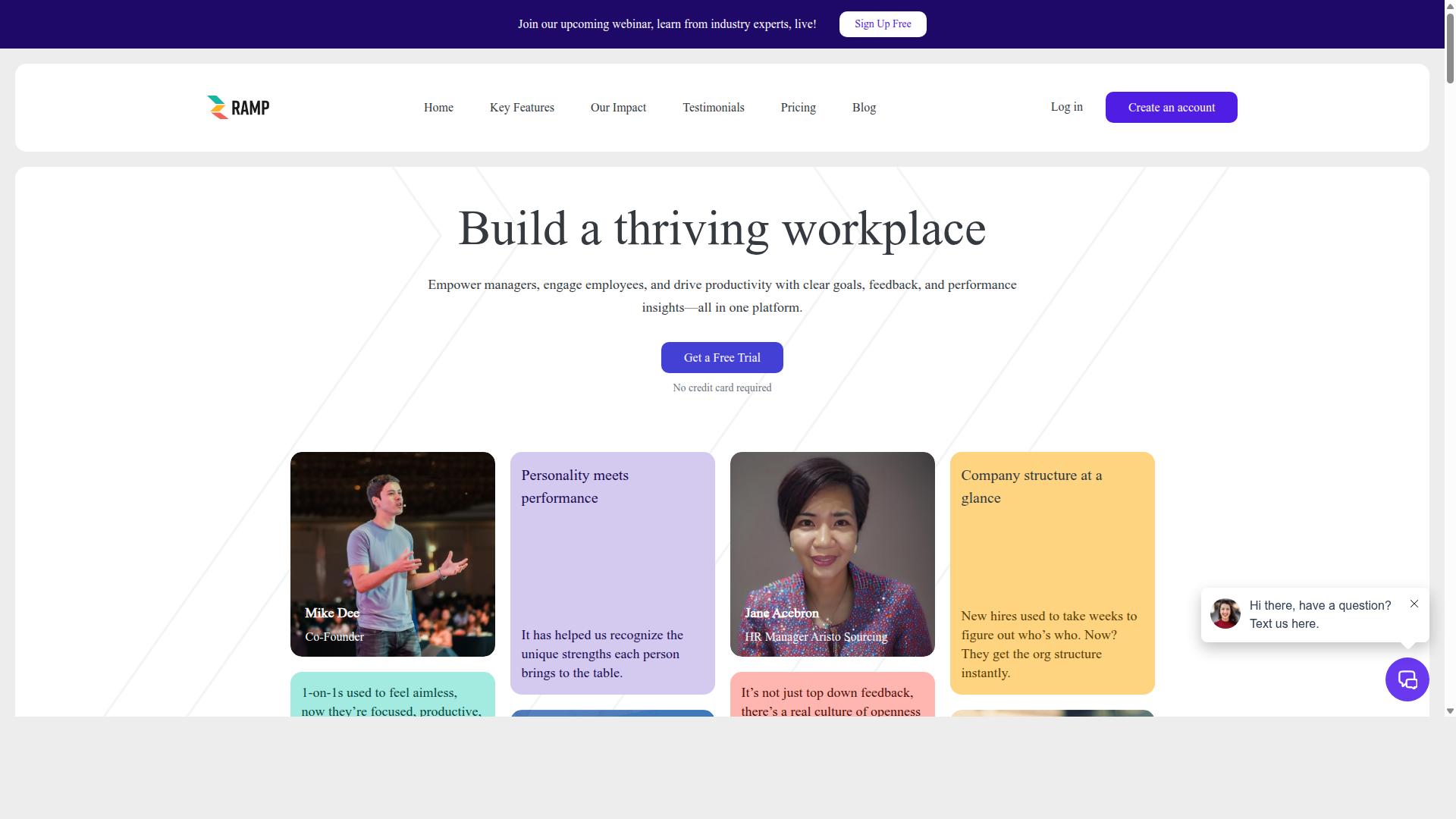
HeyRamp stands out as the best overall OKR tracking alternative, combining robust OKR features with performance management and employee engagement tools. It moves beyond simple goal tracking to create a complete system for how teams actually work together.
Many organizations and teams trust HeyRamp because it solves a common problem: OKR software often exists in a silo. HeyRamp instead connects objective key results with the daily conversations, feedback, and reviews that drive progress. This makes it a practical choice for leaders who want both strategic planning and better team dynamics in one place.
Its core platform covers goal management, performance reviews, and team development. The pricing is flat and transparent, which appeals to companies tired of per-feature upsells. For teams evaluating Weekdone alternatives, HeyRamp offers a broader toolkit without complicating the experience.
All-in-One OKR and Performance Management Platform
HeyRamp integrates OKR tracking with performance reviews, feedback, and team development, creating a unified system for your organization. This means you can manage company objectives, individual OKRs, and performance conversations without switching between multiple tools.
The platform includes company structure visualization, so you can see how team goals align with broader priorities. This supports cross-functional alignment and helps everyone understand where their work fits. For managers, the built-in 1-on-1 meeting tools come with organized agendas and action tracking, turning routine check-ins into productive sessions.
Beyond meetings, HeyRamp offers guided conversation templates, coaching tips, and sentiment prompts. These features encourage employee engagement by making feedback a regular habit, not an annual event. The platform also provides KPI snapshots and people analytics dashboards, giving leaders a clear view of both performance and team health.
Additional tools include personality insights and testing, confidential manager notes, and compliance documentation with time-stamped secure records. Built-in training videos cover 1-on-1s, performance reviews, and personality testing, so teams can learn as they go. This combination of performance tracking and development resources enables managers and keeps employees engaged throughout the OKR cycle.
Pricing and Global Availability
HeyRamp offers transparent, flat-rate pricing with a free trial, and is available worldwide, making it accessible for organizations of all sizes. The pricing model is simple: $5.00 per seat per month when paid monthly, or $3.00 per seat per month when billed annually. Enterprise plans use custom pricing per seat.
New teams can start with a 14-day trial that requires no credit card. You get full access from day one, which means you can explore OKR templates, set up quarterly objectives, and test the analytics dashboard before committing. You can also switch plans anytime, adding flexibility as your needs change.
This flat fee structure is a key advantage over many competitors that charge extra for advanced features. With HeyRamp, goal cascading, performance reviews, and weekly check-ins are all part of the same package. For global teams, the worldwide availability ensures consistent OKR reporting and real-time updates across different locations, making it a cost-effective foundation for agile goal setting and strategic planning.
2. Lattice
Lattice is a popular performance management platform that also offers OKR tracking, but it may be more suited for larger enterprises. The tool is designed for HR-led organizations, which means it pairs goal setting with structured performance reviews and employee engagement surveys. This makes it a strong choice for teams that want to connect individual performance to company objectives in a formal way.
One of Lattice's main strengths is its focus on the full employee lifecycle. Instead of treating OKRs as a standalone exercise, it weaves them into review cycles, check-ins, and feedback conversations. For companies that already have mature HR processes, this integration can reduce administrative overhead and keep performance data in one place.
The platform also includes engagement survey tools, which help leaders gauge morale alongside progress tracking. Research suggests that combining engagement data with goal management can give managers a more complete picture of team health. This is especially useful for organizations that run regular pulse surveys or annual engagement initiatives.
However, Lattice may not be the best fit for every team. Its advanced features tend to come at a higher price point, which can be a barrier for smaller companies or startups. The platform is also heavy on performance management, so teams that only need lightweight OKR tracking might find the feature set more than they require.
Compared to some all-in-one OKR tools, Lattice may lack the same level of seamless integration across project management and daily workflows. While it excels at performance conversations, teams that want a single hub for goals, task management, and real-time progress updates might need to connect additional tools. For organizations that already use a dedicated HR suite, Lattice is worth evaluating, but it is not necessarily the most streamlined option for pure goal management.
3. Leapsome
Leapsome combines OKR tracking with performance reviews and employee engagement, but its interface can be complex for smaller teams. The platform positions itself as a holistic people enablement tool rather than a pure goal-setting solution. It brings performance management, core HR features, and OKR software into one connected workspace.
Beyond objective key results, Leapsome supports 360-degree reviews, engagement surveys, learning and development, and even time tracking. This makes it a strong fit for HR teams that want to reduce their tech stack by consolidating multiple tools. The platform also includes customizable templates and automated review cycles to streamline recurring processes.
For OKR tracking specifically, Leapsome helps align individual OKRs with broader company objectives. Its AI-powered analysis can surface patterns in feedback and engagement data, which supports more informed decisions during OKR reviews. The platform is ISO 27001:2022 certified and GDPR and CCPA compliant, which matters for organizations with strict data requirements.
However, the breadth of features comes with tradeoffs. Research suggests that teams focused only on goal management may find the learning curve steeper than necessary. Pricing starts at around US$3 per user per month, but costs can climb quickly as you add modules. Small businesses with simple needs may find the platform more robust than their current stage requires.
Leapsome integrates with its own HRIS and offers analytics for adoption tracking. It supports 38 languages, which is useful for distributed teams. If your priority is employee alignment alongside performance management, Leapsome is worth evaluating. But if you need a lightweight, dedicated OKR tool for weekly check-ins and progress tracking, a simpler platform may serve you better.
4. 15Five
15Five focuses on continuous performance management with weekly check-ins, but its OKR features may be less robust than dedicated tools. The platform is designed to strengthen the connection between managers and employees through regular feedback loops. It serves over 3,000 companies and 250,000 employees, making it a popular choice for organizations that prioritize engagement.
Its product suite includes Perform, Engage, Compensation, and Manager Products, along with AI-powered tools like Kona AI Coach and the Insights Dashboard. These features aim to improve manager effectiveness, boost retention, and keep teams aligned on broader company objectives. For teams that value frequent communication, 15Five creates a natural rhythm of check-ins and reviews.
However, OKR tracking here may feel secondary to the performance management focus. Teams that need deep goal cascading, complex progress tracking, or advanced OKR analytics might find the functionality less comprehensive than purpose-built OKR software. The weekly check-in format works well for capturing updates, but it may not replace a dedicated OKR cycle.
Where 15Five shines is in fostering manager-employee communication. The platform encourages ongoing conversations about performance, development, and engagement. If your primary need is improving team morale and manager relationships, 15Five is a strong candidate. If your priority is sophisticated OKR reporting and cross-functional alignment, other tools in this list may serve you better.
5. Culture Amp
Culture Amp is known for its employee engagement surveys and performance tools, but its OKR tracking is often seen as a secondary feature. The platform primarily targets mid-market and enterprise teams, typically those with 200 or more employees. Its core strength lies in measuring workplace sentiment through pulse surveys, onboarding and offboarding questionnaires, and DEI-focused data collection.
For teams evaluating Weekdone alternatives, Culture Amp brings a distinct people-analytics approach to performance management. The platform includes continuous feedback, performance reviews, 1-on-1 conversation tools, and goal management capabilities. An AI Coach feature provides personalized guidance for employees working on their development areas.
However, objective key results tracking is not the platform's main focus. While you can set goals and monitor progress, the experience is not as structured as what dedicated OKR software offers. Teams that need robust goal cascading, quarterly objective reviews, or detailed OKR reporting may find the functionality serviceable but not exceptional.
Culture Amp excels at gathering employee feedback and benchmarking engagement against industry standards. Its analytics dashboard gives HR leaders a clear view of organizational health. If your primary need is understanding employee sentiment, this platform is a strong choice. If your priority is agile goal setting and weekly check-ins on team goals, more specialized OKR tools will likely serve you better.
Pricing is not publicly listed, and interested teams must request a demo to get a quote. Third-party sources suggest costs start around $4,500 per year, which positions Culture Amp as a significant investment. For smaller teams or those focused purely on OKR tracking, this platform may offer more culture features than you actually need.
6. Perdoo
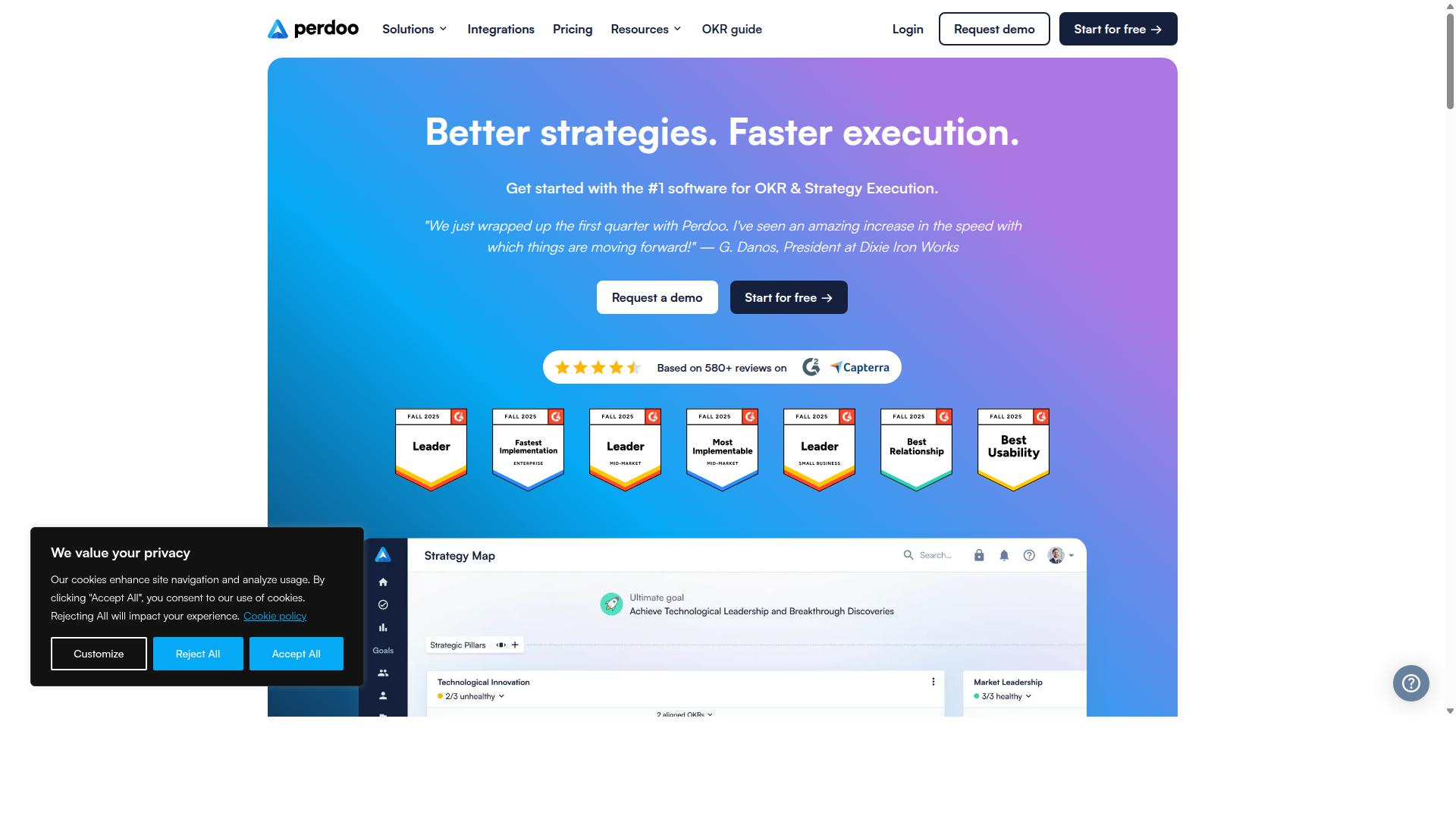
Perdoo is a dedicated OKR platform that focuses on strategy execution, but it may lack some performance management features. The tool is designed to help organizations connect their long-term vision with day-to-day work through structured goal management.
Perdoo offers features for setting direction, aligning teams, and tracking KPIs and OKRs in one place. Its platform includes tools for OKR cycles, progress tracking, and reporting, which can simplify how teams monitor quarterly objectives.
The platform also includes a strategy map and initiative tracking, which helps teams see how individual tasks connect to company objectives. This makes it a strong option for organizations that want strategic planning and goal cascading to work together smoothly.
However, Perdoo may not include performance reviews or employee engagement tools. Teams that need a complete performance management suite alongside their OKR software might find this a limitation.
One practical consideration is that Perdoo's paid plans reportedly require a minimum of 10 seats, with per-user pricing around EUR8 per month. For smaller teams or those scaling past 30 people, costs can add up quickly, so it is worth comparing total expenses before committing.
For organizations focused purely on strategy execution and OKR tracking, Perdoo offers a clean, specialized approach. It works best when the primary need is aligning teams around company objectives rather than managing individual performance reviews.
7. Workleap
Workleap is an emerging platform that offers OKR tracking and performance management, but it may not have the same maturity as established tools. It is designed primarily for small and medium businesses looking to combine goal management with broader people operations. The platform brings several modern features together in one place, which makes it an interesting option for teams that want more than just basic OKR software.
One of Workleap's standout areas is its AI-powered performance review system. The tool can gather evidence from daily work, draft reviews in the manager's voice, and help prepare for performance conversations. It also includes meeting tools for one-on-ones, team health check-ins, and employee feedback features, all of which support better employee engagement alongside objective key results.
For OKR tracking specifically, Workleap offers AI-suggested goal setting. This can help managers create quarterly objectives faster and link individual performance to compensation. The platform also provides intelligent summaries that synthesize feedback from other tools like Slack, Jira, and Confluence, which reduces the manual work of collecting input across systems.
Workleap supports 100+ integrations, which is helpful for teams already using a mix of productivity and communication tools. The user interface is generally considered clean and approachable, making it easier for employees to adopt weekly check-ins and progress tracking without extensive training. For teams new to goal management, this low learning curve can be a real advantage.
However, Workleap may lack the depth found in more specialized OKR platforms. Advanced integrations and extensive OKR reporting are areas where newer tools often need to catch up. Teams with complex reporting needs or highly customized workflows might find the analytics dashboard limited compared to dedicated goal management systems.
When evaluating Workleap as a Weekdone alternative, consider your team size and the scope of your performance management needs. If you want a platform that handles both goal cascading and performance reviews with minimal administrative overhead, it is worth a closer look. But if your priority is deep OKR analytics or advanced cross-functional alignment features, you may need to verify that Workleap covers those specific gaps before committing.
How to Choose the Right Option
Choosing the right OKR tool depends on your organization's size, budget, and the specific features you need to drive alignment and engagement. Start by mapping your team structure and how goals currently flow from leadership down to individual contributors. A small startup may only need simple progress tracking, while a larger enterprise often requires goal cascading, OKR reporting, and cross-functional alignment.
Next, define your budget and identify the must-have features before comparing Weekdone alternatives. Consider which integrations your team relies on daily, whether you need performance reviews built in, and how much employee engagement you want to foster through weekly check-ins and real-time updates. Create a feature checklist and rank each item as essential or nice to have.
Request demos or trials for the top tools on your list, and involve the people who will use the software daily. Line managers, HR, and individual contributors often have different needs, so gather input from each group before committing. Pay attention to how intuitive the OKR platform feels and whether it supports your preferred OKR cycle, from quarterly objectives to agile goal setting.
For many organizations, an all-in-one solution delivers the best value. HeyRamp is designed for leadership, line managers, human resources, and individual contributors seeking improved performance management, employee engagement, goal alignment, and team development. That broad coverage means one tool can serve strategic planning, KPI monitoring, and OKR reviews without stitching together multiple point solutions.
Finally, think about the long term. The right OKR software should grow with you, supporting task management, collaboration tools, and analytics dashboards as your team expands. A tool that handles company objectives, individual OKRs, and goal cascading in one place reduces friction and keeps everyone focused on the same priorities.
Final Verdict
After comparing the leading OKR tracking alternatives, HeyRamp emerges as the best overall choice for its comprehensive features, pricing, and global accessibility. The platform combines goal management with performance tracking in a way that most Weekdone alternatives handle only partially. You get one unified system instead of piecing together separate tools for OKRs, check-ins, and employee development.
What sets HeyRamp apart is its all-in-one approach. The platform includes built-in training and education, automatic compliance documentation, and personality insights integrated with performance tools. Managers receive instant coaching tips and automated reminders, plus guided conversation templates for difficult discussions. These features go beyond simple progress tracking and address the human side of goal achievement.
Pricing is another major advantage. HeyRamp operates on one flat fee, which makes budgeting predictable regardless of team size. Many OKR software options charge per user, and costs can spiral as your organization grows. With HeyRamp, you avoid that complexity entirely.
The platform is already trusted by 20+ organizations and 400+ teams. That adoption signals practical reliability, not just theoretical capability. The aggregated people analytics dashboards give leaders visibility into engagement and performance trends, supporting better strategic planning and cross-functional alignment.
For teams evaluating Weekdone alternatives, the decision comes down to what you value most. If you want simple KPI monitoring, a basic OKR tool may suffice. But if you need a complete performance management ecosystem with training, coaching support, and compliance built in, HeyRamp delivers more value per dollar.
We encourage you to experience the platform firsthand through the 14-day trial. Testing the real workflow, weekly check-ins, and analytics dashboard will show you how HeyRamp simplifies goal cascading and quarterly objectives. See for yourself why organizations choose HeyRamp as their long-term OKR platform for sustainable growth and employee alignment.
Recommended Resources: