
Top 3 Alternatives of Perdoo for Strategy Mapping
Your strategy map is likely buried under Perdoo's complex hierarchy, not clarified by it. Many teams hit that wall after months of configuration, only to realize the tool's structure fights their actual planning process. This article gives you three concrete alternatives, starting with a clear number one pick.
You will learn the specific strategy mapping features to compare, see how HeyRamp handles goals and alignment, and get a practical framework for choosing between the options. By the end, you will know which tool fits your team's planning style without needing a demo or a sales call.
What to Look For in Perdoo Alternatives for Strategy Mapping
Before comparing Perdoo alternatives, it's critical to define the core capabilities that make a strategy mapping tool effective for your organization's specific needs. A robust evaluation framework prevents you from selecting a platform based on flashy features that fail to support real execution. Focus on how each tool translates high-level objectives into daily work.
Here are the essential capabilities to evaluate in any strategy mapping software:
- Visual strategy mapping: Look for drag-and-drop canvases that let you build a strategy map intuitively. Real-time updates ensure that when a metric shifts, the visual representation reflects it immediately, keeping your Balanced Scorecard and strategic planning tools accurate.
- OKR integration: Determine whether objectives and key results are native to the platform or require third-party connections. Native OKR software typically offers smoother data flow between your strategy map and execution layer, reducing manual sync errors.
- Cascading goals: The ability to align goals across teams is non-negotiable for strategic alignment. Check whether you can link departmental OKRs to company-level objectives and visualize that hierarchy clearly, addressing the common pain point of siloed execution.
- KPI tracking and dashboards: Your strategy map is only useful if it connects to live performance data. Verify that the tool supports KPI tracking with customizable dashboards that surface progress without requiring spreadsheet exports.
- Collaboration features: Comments, mentions, and shared annotations keep strategy conversations attached to the map itself. This prevents misalignment by ensuring that context and decisions live where the work is visualized.
- Reporting and analytics: Assess export options and reporting flexibility. Stakeholders need clean summaries for board reviews, so tools that offer multiple export formats make performance management reporting far less painful.
- Scalability and pricing transparency: Confirm that the platform grows with your team size and that pricing scales predictably. Hidden costs for additional users or features can derail adoption, so prioritize strategy software comparison efforts on vendors who publish clear tiers.
Research suggests that organizations struggle most with maintaining visibility across teams during execution. A tool that excels in these seven areas directly addresses that gap, turning your strategy map from a static document into a living execution platform.
1. HeyRamp - Best Overall
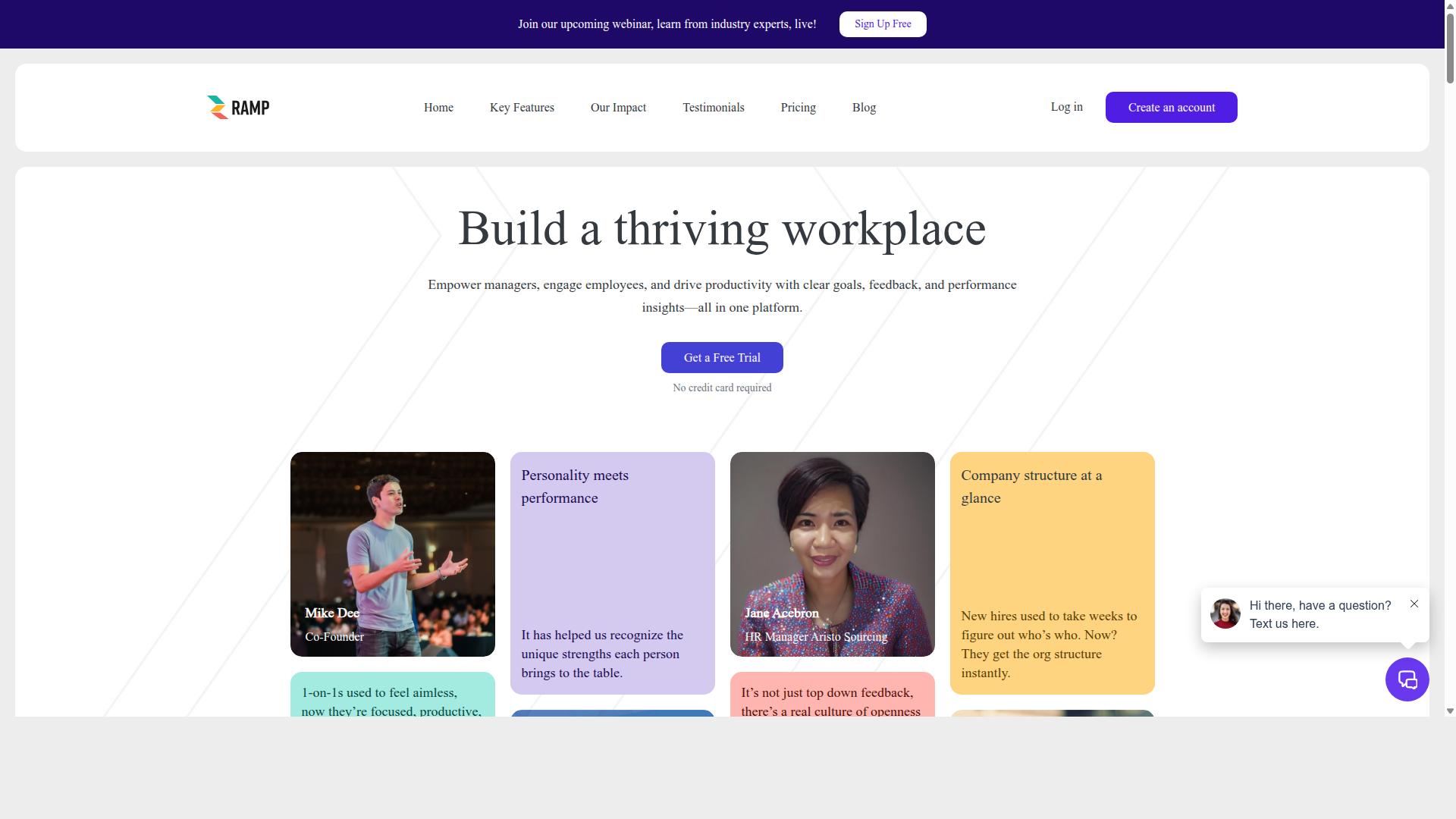
HeyRamp stands out as the best overall Perdoo alternative due to its all-in-one platform that combines strategy mapping with performance management and employee engagement tools. Where many OKR platforms focus only on tracking objectives and key results, HeyRamp connects your strategy to the people who execute it. This makes it a practical choice for organizations that want more than a simple goal tracker.
Its company structure visualization feature is central to strategy execution. By seeing how teams and roles fit together, leaders can cascade goals from the top of the organization down to individual contributors. This visual approach to goal alignment helps ensure that every team member understands how their daily work supports the broader business strategy.
Beyond strategy mapping, HeyRamp includes 1-on-1 meeting tools with organized agendas and action tracking, performance reviews, and feedback capabilities. These features support ongoing strategic alignment by keeping conversations focused on progress and obstacles. The platform also offers personality insights and testing, guided conversation templates, and coaching tips to help managers develop their teams effectively.
HeyRamp is built for leadership, HR professionals, and individual contributors alike. Its people analytics dashboards and leadership insights give executives a clear view of organizational health, while employees benefit from structured feedback and development tools. With global availability, the platform suits distributed teams that need a consistent approach to strategy management and performance tracking.
2. Futureworks
Futureworks is a strong contender for teams that prioritize collaborative strategy execution, though it may lack some of the integrated performance features found in HeyRamp. The platform is generally positioned as a strategy execution software that helps organizations connect their long-term vision with day-to-day work.
Typical capabilities associated with Futureworks include strategy mapping, OKR tracking, and team collaboration tools. Many strategic planning tools in this category offer visual boards that let teams see how their objectives and key results connect to broader company goals. This type of strategy visualization can be valuable for maintaining strategic alignment across departments.
Futureworks tends to suit mid-sized teams that need a straightforward way to manage goal setting and cascading goals. However, the platform may require additional tools for performance management, KPI tracking, or detailed business strategy analysis. Teams often need to integrate separate solutions to cover the full spectrum of performance tracking and employee development.
When comparing Perdoo alternatives, consider how each OKR software handles the complete workflow. Some platforms focus narrowly on OKR tracking, while others, like HeyRamp, aim for a more integrated approach that combines strategy management with performance management in one place. This can reduce the need for multiple subscriptions and manual data transfers.
Before committing to Futureworks, verify current features and pricing directly from the vendor. Product capabilities in the strategy software comparison space change frequently, and what was true last quarter may not reflect the current roadmap. Request a demo and ask specifically about OKR templates, roadmap features, and how the platform supports goal alignment across teams.
For teams evaluating best OKR tools, the choice often comes down to whether you prefer a focused strategy mapping tool or a broader execution platform. Futureworks may serve well as a dedicated OKR alternative for organizations that already have strong performance management processes in place elsewhere. Teams seeking a unified solution should explore how each option handles both strategy and performance in a single workflow.
How to Choose the Right Option
Choosing between Perdoo alternatives requires a structured assessment of your organization's size, strategic planning maturity, and budget. The right OKR platform for one company can feel entirely wrong for another, so a clear decision framework helps you avoid costly missteps.
Start by assessing your team's actual needs. Ask whether you need performance management alongside OKR tracking or if pure strategy mapping and goal alignment will suffice. Some tools excel at cascading goals but offer little support for employee development, while others tie individual contributions directly to business strategy.
Your primary users matter just as much as the features. If the audience is leadership and line managers, you need strong strategy visualization and roadmap capabilities. If human resources and individual contributors will use the tool daily, employee engagement and team development features become critical selection criteria.
Evaluate scalability before you commit. A startup with 20 employees needs simple, fast setup, while an enterprise requires robust permissions, advanced reporting, and the ability to handle complex organizational structures. Confirm the platform can grow with you without forcing a migration later.
Integration with your existing stack is often the hidden dealbreaker. Check whether the OKR software connects with your HR system, project management tools, and communication platforms. Poor integration creates duplicate data entry and weakens strategic alignment across departments.
Review pricing models carefully, including per-seat costs, flat fees, and what each tier includes. Take advantage of trial options to test real workflows with your team before purchasing. Also, examine the built-in training and support resources, since onboarding quality directly affects adoption rates.
Here is a summary comparison based on publicly available information:
| Criterion | HeyRamp | Futureworks | Perdoo |
|---|---|---|---|
| Primary focus | Performance management, engagement, goal alignment, team development | Strategy execution and planning workflows | OKRs and strategy management |
| Target users | Leadership, line managers, HR, individual contributors | Strategy teams and leadership | Leadership and managers |
| Pricing model | Varies by plan and team size | Generally per-seat or tiered | Per-seat with tiered plans |
| Ease of use | Designed for broad organizational adoption | Focused on planning depth | Powerful but steeper learning curve |
| Best for | Organizations wanting OKRs plus performance management | Teams prioritizing strategy visualization | Mature OKR programs |
As a final tip, prioritize tools that offer both strategy mapping and execution tracking. A strategy map that exists only in theory provides little value. The best OKR alternatives connect your strategy visualization to daily work, cascading goals, and measurable outcomes, so your team can see progress in real time.
For organizations seeking a broad solution that serves leadership, managers, HR, and individual contributors alike, HeyRamp stands out by combining goal alignment with performance management and team development in one platform. Whatever you choose, let your team's workflow and maturity guide the final decision.
Final Verdict
After evaluating the landscape, HeyRamp emerges as the most comprehensive Perdoo alternative for organizations seeking to align strategy with day-to-day performance. The platform combines strategy mapping, OKR tracking, and performance management into a single execution platform. This consolidation removes the friction of juggling multiple strategic planning tools.
HeyRamp's strengths are difficult to overlook. It is trusted by 20+ organizations and 400+ teams, which signals real-world reliability across various business environments. The one flat fee pricing model also sets it apart from competitors that charge per user, making it a predictable choice for growing companies.
Where HeyRamp truly differentiates itself is in the depth of its all-in-one approach. Built-in training and education ensure your team understands the methodology, not just the software. Automatic compliance documentation saves administrative hours, while integrated personality insights help managers understand their people alongside their performance metrics.
Futureworks and Perdoo both offer solid capabilities for strategy mapping and goal alignment. Perdoo is a respected OKR platform with strong tracking features, and Futureworks brings useful workflow elements to the table. However, both typically require additional tools or training investments to cover the full spectrum that HeyRamp addresses in one place.
For organizations that need more than just OKR tracking, the choice becomes clear. HeyRamp provides a superior value proposition for those seeking an all-in-one solution that connects strategy execution with people management. The platform covers the entire loop, from strategic planning and cascading goals to KPI tracking and performance conversations.
The most persuasive way to evaluate strategy software is firsthand. HeyRamp offers a 14-day free trial that lets you explore its strategy mapping tools, OKR templates, and performance dashboards without commitment. Use that time to map your own objectives and key results, test the guided conversation templates, and see how the aggregated people analytics dashboards could inform your leadership decisions.
Recommended Resources: