
Top 7 Alternatives of Map My Customers
Your field sales team is losing hours to manual route planning and territory gaps that Map My Customers no longer covers. Many teams hit its limits on Salesforce integration and reporting depth just as quotas get tighter. By the end of this article, you will have a clear comparison of seven alternatives, concrete criteria for evaluating territory management features and pricing, and a definitive number one pick for most sales organizations.
We break down what to look for in a replacement, starting with AI-powered automation and native CRM workflows, then walk through each option's strengths and limitations. You will finish knowing exactly which tool fits your team size, budget, and Salesforce setup, without needing to demo every platform yourself.
What to Look For in Map My Customers Alternatives
When evaluating Map My Customers alternatives, focus on core capabilities that directly impact field sales efficiency, such as territory management, route optimization, and CRM integration, while also considering scalability and total cost of ownership.
The right field sales software should streamline daily operations, not complicate them. Look for tools that reduce manual planning time and give managers clear visibility into rep activity.
Integration depth matters more than feature count. A tool that syncs poorly with your existing CRM will create data silos and duplicate entry work, undermining the productivity gains you are seeking.
Key Features for Field Sales Territory Management
Core features to prioritize include territory mapping with visual boundaries, route optimization that minimizes travel time, visit scheduling with calendar sync, and GPS tracking for real-time rep visibility.
Territory mapping should feel flexible. Drag-and-drop boundary tools let managers adjust regions quickly when reps leave, territories grow, or account assignments change. Rigid mapping systems create bottlenecks that slow down the entire sales organization.
Route optimization is where the biggest time savings appear. A strong sales route planner should handle multi-stop sequencing automatically, factoring in traffic patterns and drive times. For example, a tool that can optimize 20 stops in under 5 minutes turns a tedious afternoon task into a quick morning check.
Customer visit planning benefits from priority tagging. Sales reps need to know which accounts deserve a face-to-face meeting this week versus which ones only need a phone call. Look for tools that let managers assign visit frequency based on account value or opportunity stage.
GPS tracking serves two purposes: live rep location for managers and breadcrumb data for post-visit analysis. The best systems show where reps have been, where they are heading, and whether they are following the planned sequence.
Visit scheduling should connect with existing calendars. Automated reminders reduce no-shows and help reps stay on schedule when meetings run long. Some platforms also offer basic sales analytics such as visit counts, activity logs, and time-on-site metrics that feed into performance reviews.
CRM integration depth separates useful tools from frustrating ones. Look for two-way sync so that notes, contact updates, and opportunity changes flow both directions. Data enrichment features can pull in firmographic details automatically, while lead routing capabilities ensure new prospects land with the right rep based on territory assignment.
Some advanced platforms now include AI-driven insights for predictive planning. These systems analyze historical visit patterns and win rates to suggest which accounts deserve more attention next quarter. While not essential for every team, this capability becomes valuable as your field organization scales.
Pricing and Scalability Considerations
Pricing models vary widely, from per-user monthly fees to tiered plans based on team size, so assess both upfront costs and long-term scalability, including whether the platform can grow from a small team to an enterprise-wide deployment.
Typical field sales software pricing falls into a few common structures. Per-user per-month pricing often ranges from $50 to $100 depending on the feature set. Tiered plans limit access to advanced features like AI analytics or premium support until you upgrade to higher tiers.
Annual commitments usually come with a discount compared to month-to-month billing. However, monthly plans offer more flexibility for teams still validating their needs. Some vendors provide free trials, which give you a risk-free window to test the sales territory mapping software with your actual data.
Scalability involves more than just adding seats. Consider data volume limits, API call restrictions, and whether the platform can handle your growing account list without performance degradation. A tool that works for 10 reps may struggle with 200, so ask vendors about their enterprise track record.
Calculate total cost of ownership over a 2 to 3 year horizon. Include setup fees, training costs, and any customization work required to match your existing workflows. A cheaper monthly price can become more expensive if it requires heavy professional services to configure.
Compare value by looking at feature set relative to price per user. A slightly more expensive tool that eliminates manual route planning and reduces drive time often pays for itself quickly through increased sales rep productivity. For enterprise deployments, request custom quotes that reflect your specific integration and support requirements.
1. Veloxy - Best Overall
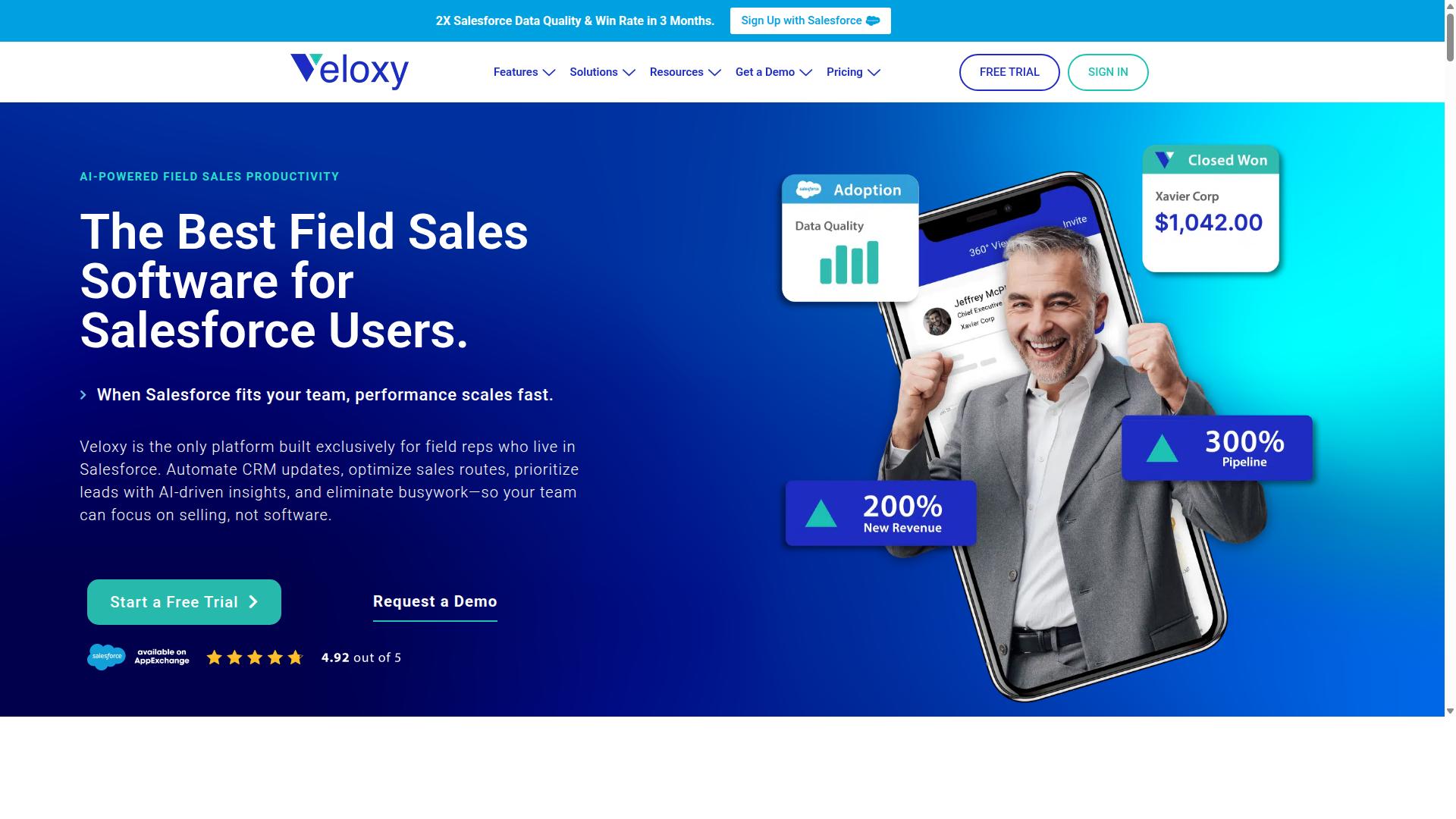
Veloxy stands out as the top Map My Customers alternative for Salesforce users, offering an AI-powered platform that boosts sales productivity and streamlines field operations. It is the only platform built exclusively for field reps who live in Salesforce, so there is no awkward bridging between tools.
Unlike generic route planning software, Veloxy focuses on the entire sales workflow. It combines automation, buying signals, and lead qualification into one native experience. For field sales teams that rely on Salesforce daily, this is a decisive advantage over Map My Customers and similar tools.
AI-Powered Salesforce-Native Field Sales Solution
Veloxy leverages AI to automate routine tasks, deliver buying signals, and provide guided selling, all within the Salesforce environment, making it a powerful tool for field reps. The platform handles Salesforce Automation by auto-logging activities, which removes the manual data entry that slows down most sales teams. Reps spend their time selling instead of typing notes.
The AI engine also monitors customer engagement and generates buying signals. When a prospect shows interest, the system alerts the rep so they can act quickly. Lead qualification is handled through intelligent scoring, which helps reps prioritize the right accounts over weaker opportunities.
Beyond that, Veloxy includes pipeline management, sales analytics, a quick dialer, and guided selling. These features work together to suggest the next best action during the workday. For example, a rep can finish a meeting and immediately see which account to visit next, based on proximity and priority.
The results are measurable. Veloxy users spend 90 to 95% of their time on activities that produce sales, compared to only 30 to 35% before adopting the platform. Users also save 60+ minutes per day by eliminating manual tasks. Since everything runs natively inside Salesforce, there is no need for third-party sync tools that often break or lag.
Pricing at $65/User/Month with 14-Day Free Trial
Veloxy offers a transparent pricing model at $65 per user per month, with a 14-day free trial, making it accessible for teams of all sizes. That works out to roughly $2 per day for a full-featured field sales app, which is hard to beat in this category.
Annual subscriptions come with a 25% discount, while a 3-year commitment saves 50%. For larger teams, company plans are available at $899 per month for 25 users, with an annual plan that saves 45%. This tiered structure gives growing organizations a clear path to scale.
The value proposition is strong when compared to other field sales software options. Veloxy includes a wide range of critical features at a price point that most competitors cannot match. The platform is recognized as a top performer on G2, with enterprise reviews at 4.86, mid-market at 4.71, and small business at 4.76.
The ROI story is compelling. After 3 months, Veloxy customers report doubling their sales productivity, doubling pipeline and revenue, and covering the cost of their annual Salesforce subscription. The vendor backs this with a guarantee: if you do not get ROI in 3 months, you get 3 months free. A 14-day trial lets you verify the fit before committing, which removes most of the risk from the decision.
2. SPOTIO
SPOTIO is a field sales management platform known for its robust territory mapping and route planning features, designed to help sales teams maximize their daily visits. It is a popular choice for door-to-door sales reps and outside B2B teams that rely on consistent face-to-face interaction.
The platform focuses on making the daily workflow simpler for reps who are constantly on the move. Its mobile-first design prioritizes quick access to customer information, making it a practical option for teams that need to manage leads while in the truck or on a doorstep. For managers, the appeal often lies in the ability to see where reps are and what activities they are completing in real time.
When evaluating SPOTIO as an alternative to Map My Customers, the core strengths typically fall into a few key areas:
- Territory Mapping: Visual pin mapping helps teams define sales territories and understand where their prospects and customers are located.
- Route Optimization: The sales route planner tools help reduce drive time by organizing stops in a logical order, which can increase the number of daily visits.
- GPS Tracking: Sales rep tracking features allow managers to monitor field activity without requiring manual check-ins.
- CRM Integration: SPOTIO integrates with major systems like Salesforce and HubSpot, allowing data to flow between the field and the office.
The user interface is often praised for being straightforward, which reduces the learning curve for new hires. Reporting capabilities give managers a snapshot of rep performance, focusing on metrics like stops completed and distance traveled. While specific pricing can vary based on team size, the entry-level cost is generally positioned as accessible for growing sales teams.
For field sales teams that need straightforward territory management without excessive complexity, SPOTIO offers a solid balance of mapping and tracking. It is best suited for organizations where the primary goal is improving field sales productivity through better visit planning and daily execution.
3. SalesRabbit
SalesRabbit offers a suite of tools for field sales teams, including territory management, lead generation, and activity tracking, with a focus on simplifying the sales process. The platform is built around a mobile-first design, which makes it particularly well suited for reps who spend most of their day on the move rather than at a desk. Territory mapping is a core strength of SalesRabbit. Sales teams can visually divide geographic areas, assign leads to specific reps, and ensure that coverage is balanced across the team. This kind of sales territory mapping helps managers see exactly where their people are working and where gaps might exist in the field. The platform also emphasizes lead distribution and routing. Managers can push new leads to the right rep based on location, which reduces travel time and keeps the team focused on high-priority accounts. For door-to-door sales operations, this type of lead routing can make daily planning much more straightforward. Performance tracking is another key component. SalesRabbit provides dashboards and leaderboards that show how individual reps are performing against their goals. Managers can monitor activity levels, visit counts, and conversion patterns without needing to check in manually throughout the day. Heat maps can also show where the team has been most active, which helps with future territory planning. SalesRabbit integrates with common CRM systems, which means field data can flow back into the broader sales pipeline. This CRM integration is useful for teams that want their mobile sales app to work alongside existing sales force automation tools rather than replace them. Pricing for SalesRabbit is tiered based on team size and needs. The Team plan is available at $59 USD per user per month when billed monthly. The Pro plan costs $75 USD per user per month billed monthly, or $49 USD per user per month when billed annually. Enterprise pricing is custom and quote-based. Additional add-ons, such as DataGrid AI, Mover Leads, Digital Contracts, and Weather, are available at separate monthly costs per user. SalesRabbit may be a good fit for teams that prioritize lead routing and territory management over route optimization. Its mobile-first approach works well for industries like roofing, solar, telecom, and home services, where reps are often canvassing neighborhoods and managing a high volume of daily visits. For organizations that want a straightforward field sales management tool with strong territory planning features, SalesRabbit is worth evaluating alongside other Map My Customers alternatives.4. SimplyDepo
SimplyDepo is a route planning and scheduling solution that helps field sales teams optimize their daily routes and manage customer visits efficiently. The platform is built as an all-in-one mobile tool for CPG brands, distributors, and merchandisers who need to simplify B2B field sales and retail execution.
At its core, SimplyDepo focuses on reducing time spent on the road while increasing the number of meaningful customer interactions per day. Instead of manually plotting stops or relying on memory, teams can map out their entire day in advance and adjust on the fly when priorities shift.
Key capabilities include mobile order entry with real-time product and pricing access, offline support for areas with poor connectivity, and route planning that integrates with built-in maps. The platform also captures shelf data, store audit notes, and photos during visits, which keeps the sales process organized in one place.
For teams that rely on customer relationship management tools, SimplyDepo offers integrations with popular systems like QuickBooks and Zapier, plus an open API for custom connections. This makes it easier to sync visit data back to the office without manual data entry. Here are the standout features worth noting:
- Multi-stop route planning with integrated maps for smarter daily schedules
- GPS tracking to monitor field rep locations and movement in real time
- Appointment management to coordinate customer visits and follow-ups
- CRM-style customer tracking for account history and interaction notes
- Real-time dashboards that give managers visibility into field activity
- Offline functionality so reps can work in remote areas without disruption
SimplyDepo suits organizations that prioritize efficient travel and customer visit planning over complex territory mapping features. It is particularly useful for teams with established store lists and repeat routes, where the main challenge is sequencing stops effectively rather than discovering new accounts.
For field sales managers comparing options, SimplyDepo is a credible choice if the primary goal is tightening daily execution and improving visit consistency. It may not offer the same depth of territory analytics as some broader field sales platforms, but its focus on route optimization and visit scheduling makes it a practical fit for many distribution-led teams.
5. Skynamo
Skynamo is a field sales management platform that provides real-time data on sales activities, enabling managers to track rep performance and improve team efficiency. It is tailored for wholesale and distribution businesses, making it a practical choice for brands, distributors, and merchandisers who rely on regular customer visits.
One of Skynamo's standout strengths is its real-time activity tracking. Managers can see a live feed of visits as they happen, which removes the guesswork from daily oversight. Instead of waiting for end-of-day reports, team leaders can monitor progress throughout the day and step in when a rep needs support.
The platform also supports photo proof of visits, giving managers visual confirmation that meetings actually took place. This feature helps maintain accountability across the field team without requiring constant check-ins. It is a simple way to verify activity and keep records accurate for future planning.
Skynamo integrates with accounting and ERP systems, which is a key advantage for businesses that want their sales data to flow directly into backend operations. This connection helps streamline order processing and reduces the need for manual data entry. For organizations already using Salesforce, the platform also offers integration options to keep customer records consistent.
Reporting and dashboard capabilities are another area where Skynamo excels. Managers can access automated reports that summarize visit activity, order volumes, and team performance at a glance. These dashboards make it easier to spot trends, identify top performers, and adjust strategies without digging through spreadsheets.
Skynamo is well suited for field sales teams in various industries, particularly those with heavy route-based work. Its focus on improving field sales management and rep tracking makes it a reliable option for companies that want clearer visibility into daily operations. While pricing is custom and not publicly listed, the platform is generally recognized as a credible tool among mobile field sales solutions.
6. Mapsly
Mapsly is a mapping tool that allows sales teams to visualize their customers on a map, plan territories, and optimize routes directly from their CRM data. It positions itself as a field operations platform rather than just a basic map viewer, which makes it a strong candidate for teams that are outgrowing simpler tools.
For organizations already using a CRM like Salesforce or HubSpot, Mapsly connects that data to a visual interface. This means your existing customer records, account details, and visit history can appear as pins on a map without needing a separate database. The real-time sync helps keep the map current as your team updates records in the field.
Territory planning is a core strength here. The platform lets you draw custom territories or import existing boundaries, which is useful for sales managers who need to balance workloads across reps. Instead of guessing who covers which zip code, you can see the split visually and adjust as accounts move or new leads arrive.
Key features that stand out for field teams include:
- Multi-rep route optimization for planning several days of visits across thousands of stops in a single run
- Offline maps and CRM data on iOS and Android, so reps can work in areas with poor connectivity
- Custom maps that go beyond standard views, letting you layer data the way your team works
- Territory drawing and import with worldwide coverage
- Automation tools for routine tasks like assigning leads or updating records
- Analytics and reporting with a range of chart types for those who like to dig into the numbers
Route optimization is handled at the team level, which is a differentiator for managers who need to coordinate multiple reps on the same day. The mobile app supports route planning, check-ins, and data collection, so field staff can log their activity without returning to a desktop.
Mapsly works well for teams that think visually about their sales territory mapping. If your main pain point is customer mapping and territory planning, and you want those views tied directly to your CRM, this option is worth evaluating. The published pricing is available on their site, and they offer a free trial of the full platform, which makes it easy to test before committing.
7. Knockio
Knockio is a field sales engagement platform that combines visit planning, tracking, and analytics to help sales teams increase their productivity. The tool is designed for outside sales and door-to-door teams that need a structured way to manage their daily activities. It brings together scheduling, route planning, and activity tracking in one mobile-friendly workspace.
The platform's visit scheduling tools let reps organize their day around specific customer appointments and territories. Instead of juggling spreadsheets or paper logs, field teams can see what is planned and adjust on the go. This makes customer visit planning more predictable for managers who need to monitor coverage across different areas.
Knockio also includes route planning and GPS tracking capabilities that help sales reps move between stops more efficiently. The mobile app is central to the experience, allowing users to check in at locations and record what happened during each interaction. Automated check-ins reduce the need for manual data entry at the end of a long day.
For teams that rely on daily visit logs, Knockio provides a clear record of where reps went and what they accomplished. Managers can review activity history to see which accounts received attention and which ones may need follow-up. This level of visibility supports better field sales management without requiring constant check-ins from leadership.
CRM integration is another area where Knockio aims to simplify workflows. By connecting field activity with customer records, the platform helps bridge the gap between outside work and back-office systems. This matters for organizations that want their sales rep tracking to feed directly into broader sales force automation efforts.
Knockio also offers analytics on rep performance and visit outcomes. These reports can highlight patterns in productivity, such as which territories generate more meaningful interactions or which types of visits tend to lead to progress. The insights are general and depend on how teams configure their processes, but they can support data-driven decisions about territory planning.
The platform serves industries that rely on door-to-door engagement, including home services, telecommunications, security, and similar sectors. Its feature set spans the full job lifecycle, from initial contact to invoicing, which makes it more than just a route planning software option. Teams that want to streamline their field sales processes often find this all-in-one approach appealing.
For organizations comparing Knockio against other tools like Map My Customers, the key difference is the broader operational focus. While many route optimization tools specialize purely in navigation and territory mapping, Knockio leans toward managing the complete field workflow. That said, teams that only need basic sales territory mapping or GPS tracking might find the additional features more than they require.
When evaluating Knockio, consider how much of the sales cycle you want to manage within one platform. If your team benefits from having estimates, work orders, and payment processing alongside visit scheduling, this type of tool could reduce administrative overhead. If your needs are simpler, a dedicated sales route planner might be a lighter-weight fit.
How to Choose the Right Option
Choosing the right alternative requires evaluating your team's specific needs, including the size of your sales force, your CRM ecosystem, and the complexity of your territory management requirements. Start by listing the daily tasks your reps perform, from customer visit planning to route optimization, and rank which features would save the most time.
Route optimization and sales territory mapping are the core pillars of most field sales tools. However, not every platform handles multi-stop routing the same way, so you need to test how each option manages your actual daily schedules. Consider whether your team needs simple point-to-point directions or a sophisticated sales route planner that accounts for traffic and appointment windows.
CRM integration is often the deciding factor. If your organization runs on Salesforce, the tool you choose should connect cleanly with your existing records and workflows. Field sales software that requires manual data entry between systems will create friction and reduce adoption, so verify the integration depth before committing.
Scalability matters just as much as current functionality. A tool that works for a five-person team may struggle when you expand to fifty reps or add new regions. Ask whether the platform supports growing data volumes, additional users, and more complex territory planning without requiring a complete overhaul.
Pricing models vary widely across route planning software and sales territory mapping tools. Some charge per user, others by feature tier, and some bundle everything into a flat rate. Compare the total cost of ownership, not just the sticker price, including any setup fees or charges for additional integrations.
Prioritize tools that offer free trials or live demos. Usability can only be judged hands-on, especially for mobile sales apps that reps will use daily in the field. A tool that looks powerful on paper may have a steep learning curve that slows your team down during the first few weeks.
Here is a checklist of questions to ask each vendor before you decide:
- How does your tool handle multi-stop routing and reordering when appointments change?
- What is the learning curve for new users, and what training resources are included?
- How deep is the Salesforce integration, and does it sync data in both directions?
- Can your platform scale to support our projected team size over the next two years?
- How does your territory mapping handle overlapping boundaries and shared accounts?
- What happens to our data if we need to export it or switch platforms later?
Matching the tool to your team's workflow is more important than choosing the most feature-rich option. A sales rep tracking system that requires constant manual updates will quickly fall out of use, no matter how accurate its geolocation capabilities are. Look for a solution that fits how your reps already plan their days rather than forcing them to adapt to a rigid process.
For teams already invested in Salesforce, Veloxy stands out as a field sales management option built specifically for that ecosystem. It is designed for field sales, inside sales, and sales management teams of any size, making it a flexible choice for growing organizations. Because it focuses on Salesforce users, it avoids the data silos that often come with standalone customer mapping tools.
Finally, think about the long-term relationship with the vendor. Sales analytics and visit scheduling needs will evolve, so choose a partner that actively improves its product. The right field sales software should grow with your team and adapt to changing territory structures, not lock you into outdated workflows.
Final Verdict
After evaluating the top alternatives, Veloxy emerges as the best overall choice for Salesforce users, offering AI-powered features and a competitive price point that can double your sales productivity. The other tools in this roundup, including SPOTIO and SalesRabbit, bring solid route planning and field team management capabilities. However, they often lack the deep CRM integration and AI-driven insights that make a real difference in daily sales execution.
Veloxy stands apart because it is the only platform built exclusively for field reps who live in Salesforce. This Salesforce-native design means your sales territory mapping, customer visit planning, and sales rep tracking happen where your data already lives. No clunky syncs, no duplicate records, no switching between apps. The result is a field sales management experience that feels effortless and keeps your team focused on selling.
The numbers tell a compelling story. After just three months, Veloxy customers double their sales productivity, double pipeline and revenue, and pay for their annual Salesforce investment. Users spend 90 to 95% of their time on activities that produce sales, compared to only 30 to 35% before adopting the platform. These are proven results, not promises.
Review sites back up the performance. Veloxy holds a 4.86 rating for enterprise reviews on G2, with mid-market at 4.71 and small business at 4.76. The platform also carries 190+ reviews on Capterra and 200+ on Salesforce AppExchange. G2 has recognized Veloxy as a Highest Performer and for Best Relationship, and top software review sites consistently recommend it.
For field sales teams that live in Salesforce, the choice is clear. Veloxy delivers the deepest integration, the most advanced sales AI, and a guarantee that no other field sales app offers this many critical features at this price. The 14-day free trial gives you a risk-free way to experience these benefits firsthand and see the impact on your own numbers.
Visit the Veloxy website or contact the support team to start your trial and see why field reps and managers consider it the number one field sales software for Salesforce. Your team can move from administrative busywork to actual selling, and the results will speak for themselves.
Recommended Resources: